Loading...
Serving Moline, IL and surrounding areas. (309) 581-0445
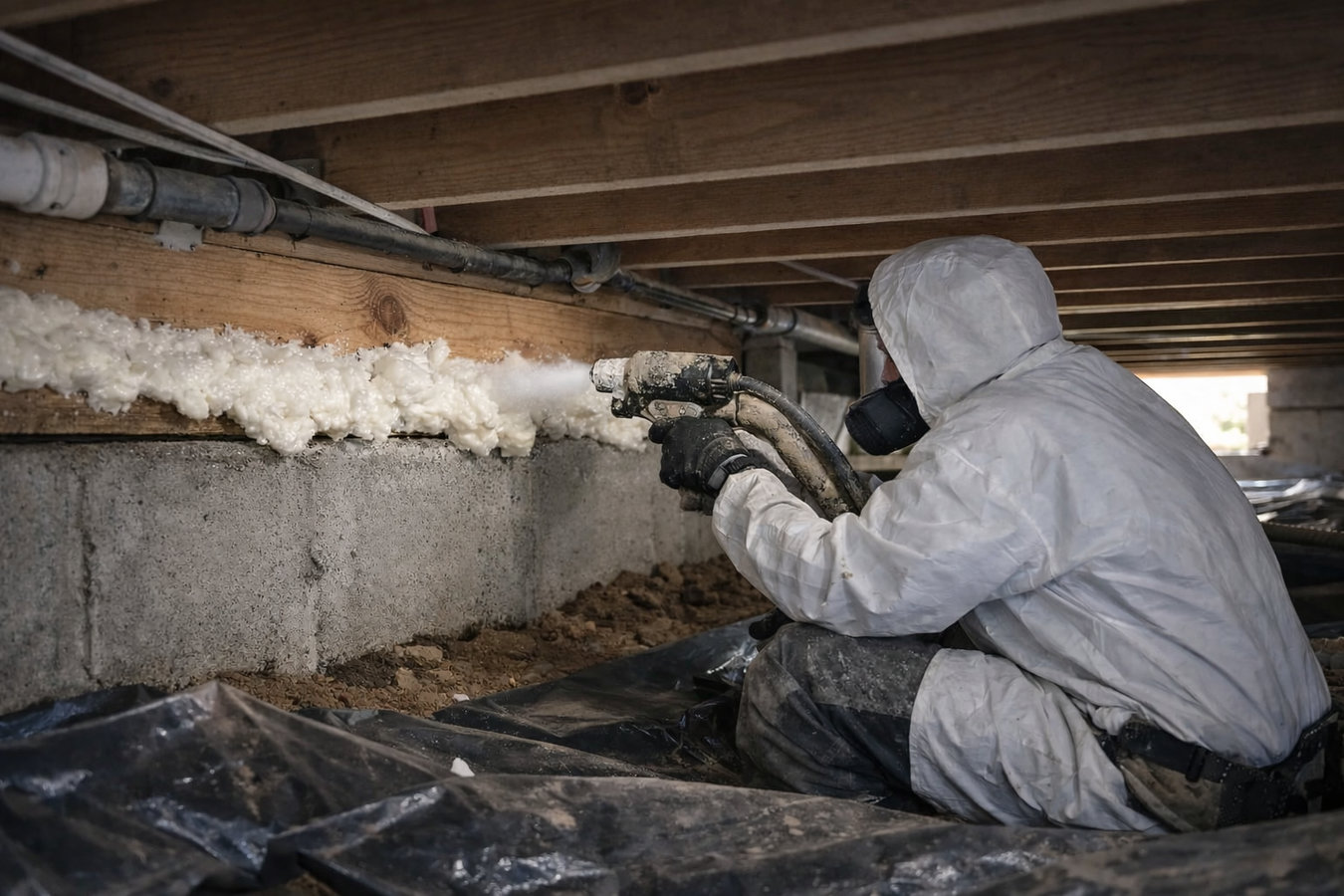
Cold floors and climbing gas bills often trace back to the crawl space. Proper insulation stops heat loss at the source and protects your pipes through Moline winters.
Crawl space insulation in Moline, IL acts as a thermal barrier between the cold ground and your living floors - most jobs take one to two days depending on the size of the space and whether old material needs to come out first.
Without it, cold air and moisture from below move upward into your living space, making floors feel cold underfoot even when the heat is running and forcing your furnace to work harder than it should. A large share of Moline's homes were built in the mid-20th century, when crawl space insulation standards were minimal or simply nonexistent. If your home was built before the 1980s, the crawl space may have no insulation at all, or fiberglass batts that have fallen, gotten wet, or deteriorated over decades. Adding or replacing that material is one of the most direct ways to reduce heating costs and improve comfort.
For many homeowners, crawl space work is paired with a crawl space vapor barrier to control moisture at the same time. The U.S. Department of Energy recommends addressing both insulation and moisture control together for the best long-term outcome.
If you walk across your kitchen or living room in winter and the floor feels noticeably cold underfoot - even with the thermostat set to a comfortable temperature - cold air is moving up from below. In Moline's winters, an uninsulated or failed crawl space lets ground-level cold transfer directly into your living space.
A persistent earthy odor - especially noticeable in the morning or after a rainy spring along the river - often originates in the crawl space. Moline's humidity levels, elevated by proximity to the Mississippi, make crawl spaces without proper vapor barriers into breeding grounds for mold that slowly vents into the living space above.
If your gas bill has gone up over the past few winters with no change in habits or thermostat settings, heat loss through the crawl space is one of the most common culprits. Moline's heating season runs roughly from October through April, and a home leaking heat through the floor works the furnace harder every day of that stretch.
If you had a pipe freeze or a plumber warned you about frozen-pipe risk, the crawl space insulation is almost certainly part of the problem. Moline regularly sees temperatures cold enough to freeze exposed pipes, and a properly sealed and insulated crawl space keeps the temperature in that space above freezing even on the coldest nights.
We install crawl space insulation using two main approaches depending on your home and the condition of the space. The first - insulating the floor joists above the crawl space - is the traditional method and works well in many situations. The second - encapsulation - seals the entire crawl space with a heavy-duty vapor barrier and insulates the walls instead, turning the space into a semi-conditioned area. For most Moline homes, especially those near the river corridor with elevated humidity, encapsulation delivers better long-term results because it controls moisture far more effectively. We also pair crawl space insulation with a crawl space vapor barrier when moisture is a concern, and we offer wall insulation for homeowners who want to address multiple areas at once.
Before any installation begins, we assess the current state of the crawl space - checking for standing water, failed vapor barriers, sagging or wet insulation that needs to come out first, and pest entry points. Moisture control is part of the job, not a separate project. Installing insulation over a moisture problem does not fix it - it hides it and can make it worse. We do not move forward until the space is dry and stable.
Insulation fitted between the joists above the crawl space - a practical choice for homes without significant moisture issues.
Full sealing of the crawl space with a heavy-duty vapor barrier and wall insulation - best for homes with humidity or moisture exposure.
For crawl spaces where existing material has failed, sagged, or been damaged by moisture or pests.
Paired install that addresses both thermal performance and moisture at the same time - recommended for most Moline homes near the river.
Moline sits in a climate zone where winters regularly drop well below freezing - sometimes into the single digits or below zero. That kind of cold pushes hard against any gap in your home's thermal envelope, and a poorly insulated crawl space is one of the biggest gaps there is. Homeowners in Moline feel this directly as cold floors, higher gas bills, and pipes that are at real risk of freezing during the coldest stretches. The city also has a housing stock where a large share of homes were built in the mid-20th century with crawl space insulation standards that were minimal at best. If your home was built before the 1980s, there is a real chance the crawl space has either no insulation or material that has deteriorated well past the point of usefulness. We work with homeowners throughout the area, including in Milan and Coal Valley, where the same older housing conditions and cold-weather challenges apply.
Moline's location along the Mississippi River corridor adds another layer of challenge. The surrounding soil and air carry more moisture than in drier inland areas, and that humidity finds its way into crawl spaces - especially in spring and early summer when ground temperatures are still cold but air temperatures rise. Homeowners here are more likely to need a full vapor barrier alongside their insulation, and sometimes a crawl space dehumidifier, to address the moisture that insulation alone cannot stop. The ENERGY STAR crawl space guidance recommends addressing moisture alongside insulation for exactly this reason.
We ask a few basic questions - your home's age, whether you have had any moisture issues, and what is currently in the crawl space. We respond within 1 business day and schedule an in-person visit, because no honest estimate can be given without seeing the space.
We access your crawl space - usually through a floor hatch or exterior panel - and evaluate the current insulation, vapor barrier condition, any signs of moisture or mold, and the overall dimensions. This visit typically takes 30 to 60 minutes, and we walk you through what we found before we leave.
You receive a written estimate explaining what needs to be done and what it will cost - including whether old insulation needs to come out first and whether a vapor barrier is included. We explain whether a permit is needed for your specific project. Do not accept a verbal quote only.
Most jobs are completed in one day. The crew removes old material if needed, installs insulation and the vapor barrier, and seals any air gaps found. Before leaving, we walk you through the work - or provide photos of the finished crawl space if access is difficult - so you know exactly what was done.
Free estimate, written quote, no obligation. We respond within 1 business day.
(309) 581-0445Installing insulation into a damp crawl space locks in the problem instead of solving it. We check for standing water, condensation, and vapor barrier failure before any new material goes in - because skipping that step is how new insulation fails in under two years.
A large share of Moline homes were built before 1960, and the crawl spaces in those homes often have original insulation - or none at all - alongside aging vapor barriers and tight access points. We have worked in enough of these spaces to know what to expect and how to work around it.
Crawl spaces are out of sight once the hatch is closed. We document the finished work with photos so you have a clear record of what was installed, where, and how - not just someone's word that it was done right. The Building Performance Institute recommends this kind of verification as a standard practice.
Not every home needs full encapsulation, and we will tell you that honestly. We match the approach to your specific crawl space conditions, moisture level, and budget - rather than defaulting to the most expensive option.
Crawl space work is easy to do poorly because the space is out of sight. We treat it as foundational - because everything above it depends on getting it right.
Pair crawl space work with wall insulation to address heat loss from multiple directions in older Moline homes.
Learn MoreA heavy-duty vapor barrier controls ground moisture that insulation alone cannot stop - especially important near the river corridor.
Learn MoreMoline winters are long - getting your crawl space sealed before the cold arrives protects your pipes, warms your floors, and starts saving on heating bills right away.